February 2009

You are currently browsing the monthly archive for February 2009.

A friend of mine recently became a fan of TED (Technology. Entertainment. Design) and it led me to watch this 18 minute talk on creative genius by Elizabeth Gilbert, author of Eat, Pray, Love.  She talks about inspiration, where it comes from, how people deal with it, and offers an idea of how to we can channel it as a positive force rather than a destructive one (often afflicting tormented artists).

It’s quite an interesting, if not inspirational, talk in itself and I recommend it for a watch to anyone who has to deal with the creative process in their work (hopefully all of us).

For me personally, Paris by Train draws its inspiration from the belief in spreading knowledge and having a positive impact on people’s lives.  One of the biggest effects I hope this site has is to reduce anxiety.  It can be a tough thing to set foot in a country where there may be serious barriers to communication.  The idea of not being able to get to shelter or to feed yourself due to an inability to simply communicate is a scary thought. And to some it is enough to stop cold any ideas or dreams of visiting far off places to experience different cultures and perspectives.  So, Paris by Train is my small stab at helping make this leap of faith by travelers a little bit less scary, allowing them to focus on the beauty of discovery & learning different places & people.  To help people look forward to such an experience with anticipation instead of anxiety, I think is something well worth the effort.

To find a route from CDG to a Metro station use the Paris Metro Journey Planner, operated by the Paris public transit authority - RATP.

Find a route from CDG to Paris Metro Station

Here is a step by step example of finding a route from CDG Airport Terminal 1 to St. Sulpice Metro station in Paris.

Step One - Route Planner

First, open up the Paris Metro Route Planner in a web browser. You’ll see a page similar to the one shown here.

Step Two - Departure Metro Station

First decision to make: Address or Station?  If you know the name of the Metro station closest to your final destination, click on the radio button next to Station

In this example, we’re leaving from CDG Airport Terminal 1.  To enter your departure station enter: Aeroport CDG 1

If you’re arriving at CDG Terminal 2 enter: Aeroport CDG 2. To find a route from CDG Terminal 3, use Aeroport CDG 1 as this is the closest station to Terminal 3.

Step Three - Destination Metro Station

Next, we’ll select a Destination station.  In this example we’re going to St. Sulpice Metro station.  Select the Station radio button and type St Sulpice in the text box below.

Step Four - Options

By default the route planner will search for the fastest route between the departure and destination stations.  At times this can result in several connections between several Metro or RER train lines. If you’re traveling with heavy luggage or suffer from mobility issues, choosing fewest connections or shortest walking distance options may result in a better route.

Step Five - Departure Time & Date

There is an option near the bottom of the Route Planner that allows you to enter the Date and Time that you plan on making this journey.

It’s important to specify the same day of the week and approximate time of day (in 24 hour clock) that you will be making this trip to get accurate results.  You do not have to specify the exact date & time of travel if this information is not available.  If you’re not sure of when you’re traveling, simply choose a time and day that makes sense, i.e. don’t use a time in the middle of the night. Somewhere between 8am to 9pm (21 hours) will give you good results.

Step Six - Being Precise

Click the Search button (bottom right corner) to start the Route Planner.

99% of the time the Paris Metro Route Planner will not show you a route, but will instead ask you to specify more precisely the departure and destination stations

The Paris Metro Route Planner will ask you to select from station names that closely matched your search criteria (Aeroport CDG 1 and St Sulpice).

Most of the time the suggested stations are correct, but you can click on the selected items to see the other suggestions.  Above are the exact station names that the Paris Metro Route Planner needs to use.

Finally, click again the Search button.

Important! The Paris Metro Route Planner will open a new browser window to show you the route results. This is considered a “Pop-Up Ad” by most browsers such as Firefox or Internet Explorer and their Pop-Up Blockers will not show the route planner results window.  You need to allow your web browser to show this Pop-Up Window, either permanently or just for this session.  To permanently allow the Route Planner to show Pop-Up Window route results, see the Purdue University page on allowing Pop-Ups from certain websites.  For the “address of Web site to allow” use: ratp.info.  The RATP uses several Web servers to provide the Route Planner results, so it is important to specify only “ratp.info” rather than www7.ratp.info or something similar since that number “7″ will change from time to time as the website spreads out the server traffic load to several different Web servers.

Step Seven - Review Route Planner Results

The Pop-Up Paris Metro Route Planner results page will show something similar to this:

Examining Route Planner Results

Looking closer at the results we see that the Paris Metro Route Planner gives total Travel Time for the journey (51 minutes).

Each part of the journey is broken down into steps specified along the left hand side column (1 & 2):

Each step shows details on which line you must take, in which direction, and which station you need to descend or stop at.

This first step specifies the type of train: RER, the line: B, the direction: Saint-Remy-les-Chevreuse, from the departure station: Aeroport Charles de Gaulle 1, and the destination station which is either your final destination or the station where you’ll need to transfer to another line: Chatelet Les Halles. At the airport train stations, on the train platforms, you can verify the direction of the RER train by looking at the overhead television screens which show the direction and departure time of the train.

Note: the direction for trains leaving CDG is not important if you’re destination is within city centre Paris, since the RER B train stops at all RER B stations within Paris itself: Gare du Nord, Chatelet Les Halles, St Michel Notre Dame, Luxembourg, Port Royal, Denfert Rochereau, and Cité Universitaire.  Thus, if you see a different direction name listed on the overhead television information screens than the one you received from the Route Planner, don’t panic, the train will stop at all the downtown Paris RER stations.

See the following photo guide articles for more information on catching the RER B train from Paris CDG Airport to Paris city center: CDG Airport Terminal 1 to Paris and CDG Airport Terminal 2 to Paris.

In this example, the second leg of the journey is completed on a different type of train: the Paris Metro, Line 4.  In this step, direction is very important.  Every Paris Metro line will have two (or more) directions which are specified by the name of the last station on the line (the terminus station) at that end of the line.  In this case, the direction is Porte d’Orleans.

When you are transferring from the RER B train line to Metro Line 4 at station Chatelet Les Halles, you’ll have to follow signs within Chatelet Les Halles that show Metro Line 4 and the direction Porte d’Orleans, if the sign you’re reading denotes directions.  Not all signs within Metro stations show line directions (to save space) and some signs show both directions, since you’re so far away from the actual Metro train plaforms that the path you’re on leads to both sides (and directions) of the Metro line.  Only when you get close enough to the two train platforms, each heading in opposite directions, will the Metro signs start specifying a single direction/terminus station.  For this particular trip, the opposite direction for Metro Line 4 is Porte de Clignacourt, but we’re after Porte d’Orleans.

On the right hand side of the Route Planner results is a column specifying the time each part of the journey will take, including walking time (in green) to the train platforms themselves.

The final piece of information on the Route Planner results is the Paris Fare Zones you’ll be crossing during your journey.  This tells you the approximative cost of the trip and the type of ticket required for the journey.

In this case, CDG Airport to Paris (any Metro station) is a special fare and is priced as such: 8,40€.  For journeys purely within the Paris Metro system, the Fare Zones are 1-2, and will require only a single Ticket t+ at a current cost of 1,60€ (as of Feb. 2009).  Any journeys beyond zones 1-2 will require additional Ticket t+ tickets good for the Metro and Bus, or special station to station priced tickets called Billet Ile-de-France.  Tip: Billet Ile-de-France tickets, when arriving or departing in central Paris, such as on this trip from CDG Airport to Paris, are good for both the Paris RER and the Paris Metro; you’ll use this single ticket on both types of trains to complete your journey.

Ready to try this for yourself?  Here is a pre-saved version of the above journey: Aeroport CDG 1 to St. Sulpice Paris Metro Route Planner search.

I recently met Rosa Jackson, a Canadian culinary educator & prolific food writer based in Nice & Paris.  She currently offers French Provençal cooking classes in sunny Nice with her cooking school Les Petits Farcis.  When not in Nice, she’s leading culinary/market tours in Paris (Edible Paris).

If you’re looking to get to know the local food scene in either Paris or the Provence region of southern France, you need to get in touch with Rosa at either Edible-Paris.com or PetitsFarcis.com.

Read about a typical cooking class with Rosa at Gourmet magazine.

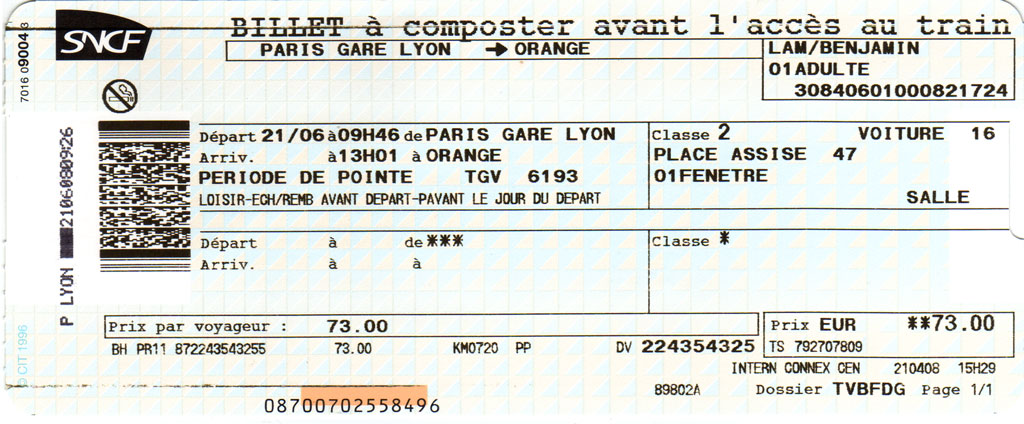
TGV Pro train ticket exchange & refund policies are unique.  I’ll attempt to explain the conditions of sale for these business class TGV train tickets below.TGV Ticket

First misconception: Pro tickets are first class train tickets.  This is not true.  Pro tickets can be bought for seats in either the first class or second class train cars on TGV trains

The main difference between Pro (Business) and Loisir (Leisure or Economy or other types of) tickets is their refund/exchange policy.

Exchange and Refund Conditions for TGV Pro tickets:

  • TGV Pro tickets are exchangeable for another TGV ticket on any other TGV train route, without exchange fee, up until your train leaves. You must pay any differences in fares, if applicable.
  • TGV Pro ticket holders, from one hour before your scheduled departure to one hour after your scheduled departure, may take trains on the same route, without exchanging your ticket.  This does not guarantee you a seat!  If you have time, you should visit a automated ticket vending/exchange machine (Yellow for any type of TGV ticket, Purple for Pro TGV tickets) to officially exchange your ticket and reserve a seat.
  • TGV Pro tickets are fully refundable up until the time of departure of your scheduled train, free of cancellation fees.
  • After your scheduled train departs and up until 60 days afterwards, you will lose 50% of your ticket value for any refund or exchange of the ticket.  After 60 days, an unused TGV Pro ticket is worthless.
  • Exchanging/Refunding tickets using automated machines or ticket counters in any major train station is free of charge.
  • You may cancel/refund a TGV Pro ticket by telephone at any time up until 60 days after scheduled departure. To speak to a SNCF travel agent by phone to exchange/refund tickets call 08 92 35 35 01 when in France (0,34€/min).

If you are unsure of your travel plans in terms of schedule, it may make sense to purchase TGV Pro train tickets. Loisir tickets are exchangeable, free of service charge, up until the night before the day of travel.  On the day of travel, Loisir TGV tickets are subject to a 10€ exchange/refund fee (plus difference in fares if applicable).  After the departure of your scheduled train, Loisir tickets are worthless.

Luggage Storage CDG

Update March 20, 2010: CDG Luggage Storage services are still in operation.  There have been rumours that luggage storage at CDG Terminal 1 and Terminal 2 have been closed due to security concerns, but this is patently false. I’ve spoken directly with Aeroports de Paris representatives who confirm that Bagages du Monde is operating normally.  I’ve included their correspondence at the end of this article for your reference.

Luggage storage at CDG Terminal 1 is located at Gate 14, Depatures level
Luggage storage at CDG Terminal 2A - Gate 3 Departures level
Baggage storage at CDG Terminal 2F - Gate 4 Arrivals level (one level down from Departures, ground level).

There is no baggage storage at the CDG RER/TGV Train station itself.

Below is a photo of the luggage storage service counter at Paris Airport Charles de Gaulle (Terminal 2F Arrivals level, third kiosk on the right). The name of the baggage storage company is Bagages du Monde.

Please keep in mind that the baggage storage company at CDG is not open 24 hours a day. Be sure to check that it will be manned when you need to collect your luggage.

Read the rest of this entry »