July 2008

You are currently browsing the monthly archive for July 2008.

Photo of the front of Gare Montparnasse in the 6th Arrondissement of Paris, opposite Montparnasse Tower (Tour Montparnasse).

Gare Montparnasse to Metro

The following section will explain how to get to the Metro station at Gare Montparnasse if you’ve recently arrived via bus or on foot.
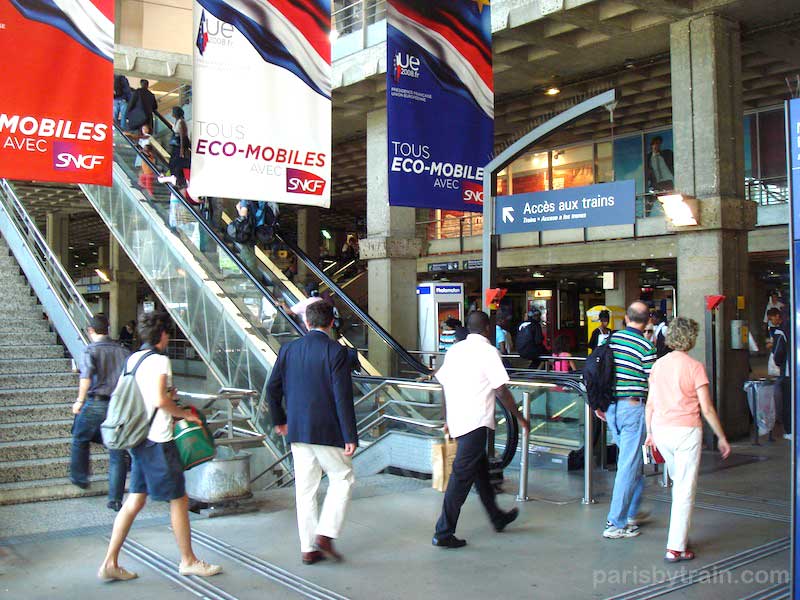
Upon entering Gare Montparnasse from street level (Niveau 0), you’ll have stairs and escalators leading up to the main train lines (TGV, Ter, Transilien, two floors up on Niveau 2) on Level 2 or you can continue forward towards to the Metro area.
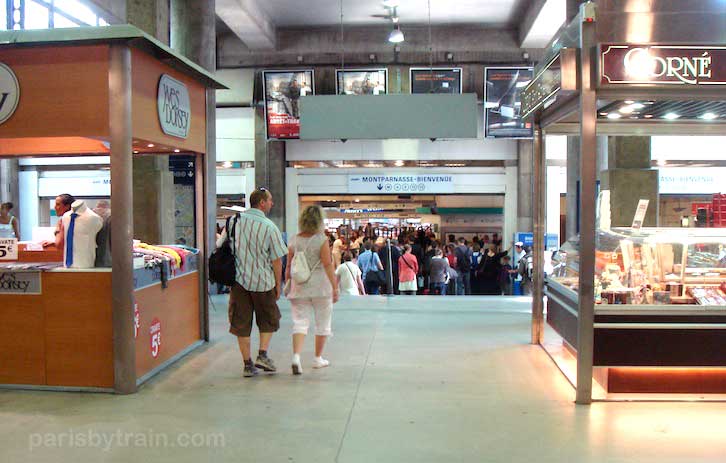
From the entrance of Gare Montparnasse, walking straight ahead and down, you’ll enter Sublevel 1 (Niveau -1) where you’ll find the entrance for Metro lines 4, 6, 12 and 13.
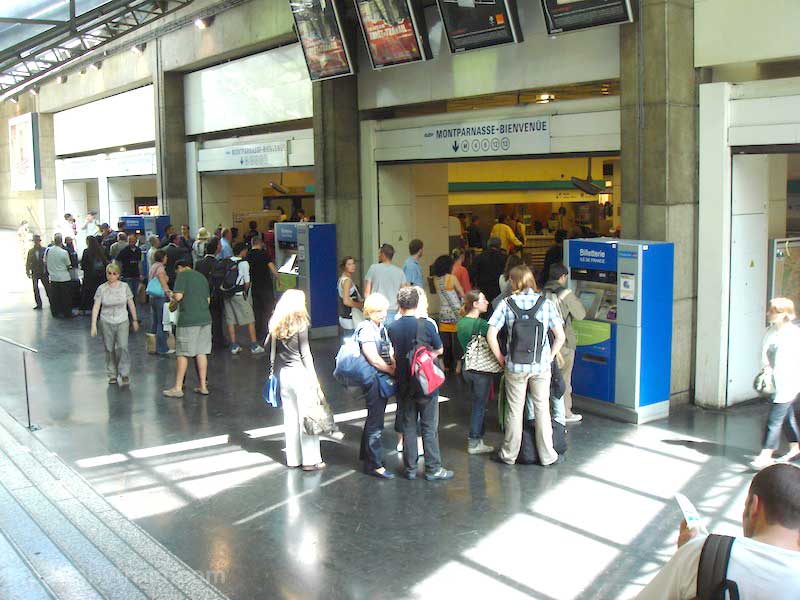
Here we see the entrance for Montparnasse’s Metro station just after the arrival of a Grandes Lignes train from the upper levels, hence the crowd.  As you can see from the overhead signs in the photo above, Montparnasse’s Metro station connects to Paris Metro lines 4, 6, 12 and 13 (see Metro map). Just past the overhead signs are two ticket windows on either side of the hall and several blue Billetterie Ile-de-France ticket vending machines scattered throughout.
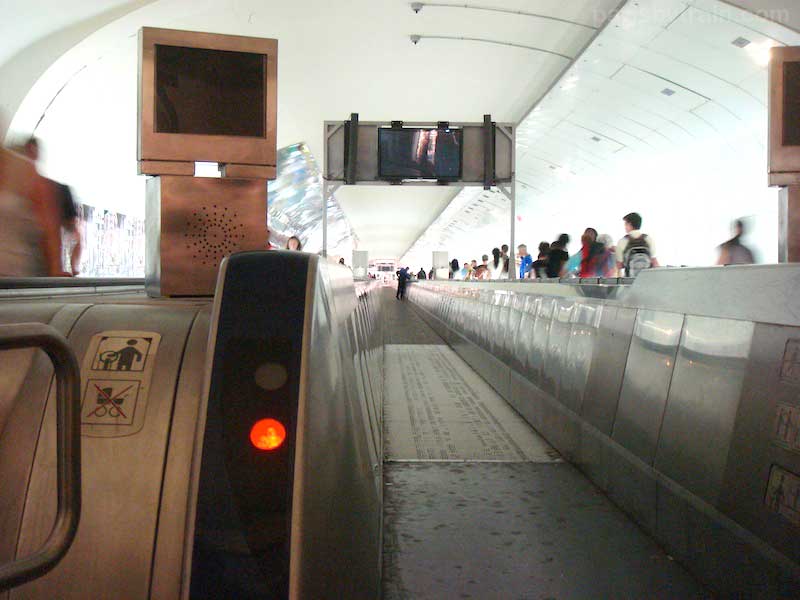
After purchasing your tickets or passes and passing through the turnstiles you’ll need to traverse a long tunnel to where the Metro lines are actually located, which is quite far north Gare Montparnasse (the train station).  Due to the length of this walkway, the transit authority is experimenting with a high speed moving sidewalk, shuttling pedestians along at 9km/h rather than the normal 3km/h.
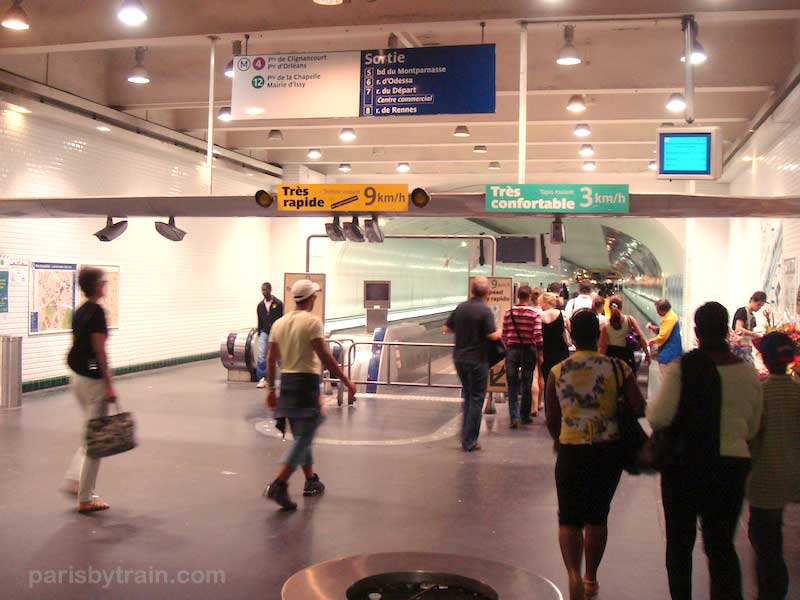
After the tunnel you’ll be at Montparnasse’s Metro station called Montparnasse Bienvenue.  Here you’ll have access to lines 4, 6, 12 and 13. For more information on taking the Metro, see the Paris Metro photo tour.

Arriving at Montparnasse from Metro

If you’re arriving at Gare Montparnasse from the Montparnasse Bienvenue Metro station, the photo below is the view you would have of the entrance of Gare Montparnasse (and the exit of the Metro area). At the top left of the photo is an overhead sign (in white) for Trains Grandes Lignes and Trains Ile-de-France. If you’re making a connection to a TGV, Transilien, Ter or Corail train departing from Gare Montparnasse, these are the signs and directions you’ll want to follow.
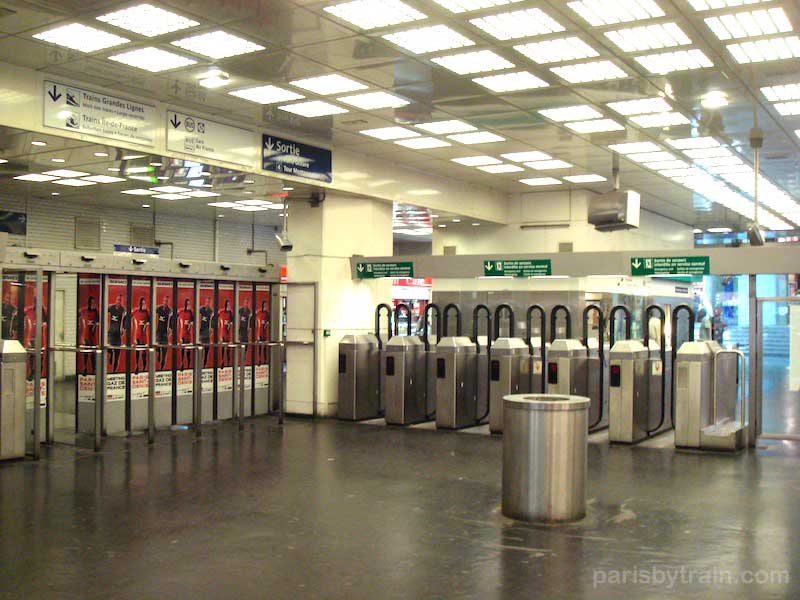
Just past the exit barriers from the Montparnasse Metro (red doors on the left), past the Metro ticket sales hall and ticket vending machines, up the few short steps, you’ll enter an area with shops, escalators and four sets of stairs leading up, two in front, two to either side (see below photo). Near the center of the photo is a small blue sign reading Grandes Lignes with an arrow pointing up. Take those stairs (or the escalators) and climb up 3 levels to Niveau 2 to get to the TGV, Ter and other intecity trains. After this point you may only see signs that read: “Access Aux Trains”. That refers to the Grandes Lignes Trains at Hall Maine so you may follow these signs as well.
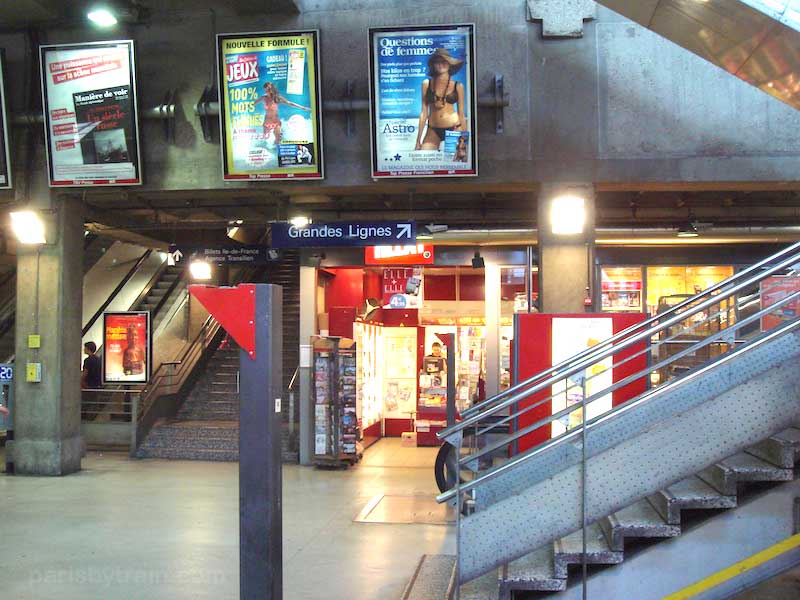
If you’re traveling to Paris suburbs rather than far away cities in France, you’ll want to climb only one level to the Transilien Ile-de-France train level (street level, also known as Niveau 0 or Rez-de-Chaussée).  The photo below shows the Transilien train ticket purchase area and entrance:
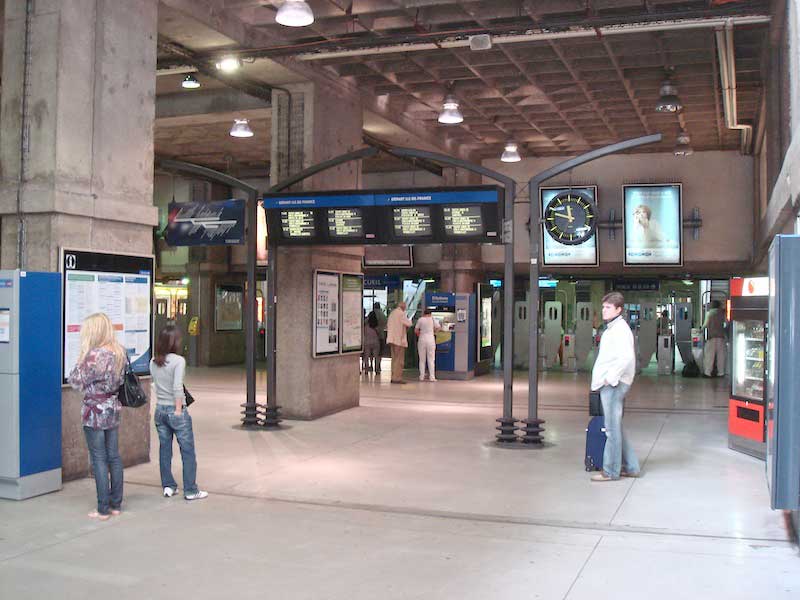
Tickets for Transilien trains can be purchased from Billetterie Ile-de-France train ticket vending machines and from the ticket window just off to the right in the above photo.

Montparnasse TGV Trains & Tickets
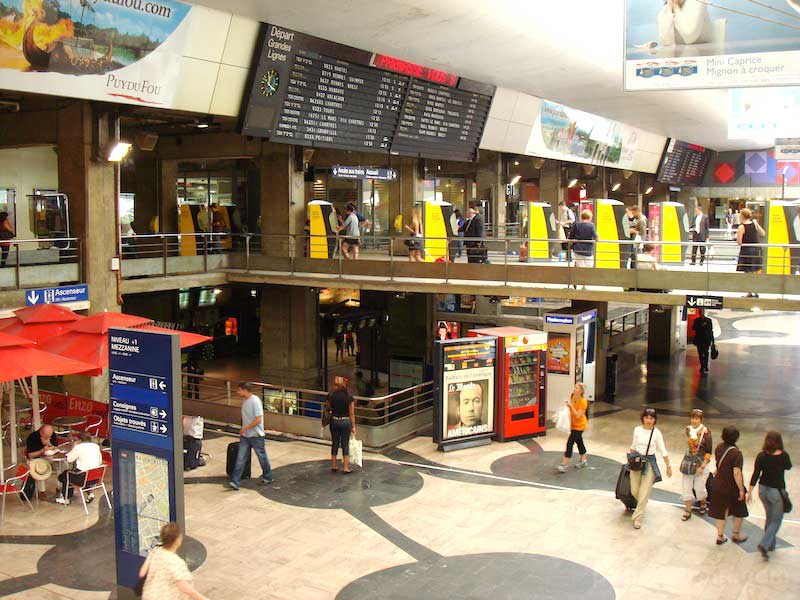
Back to Gare Montparnasse’s main train station section. Above is a photo of multiple levels of Gare Montparnasse, taken from Level 2 (”Niveau 2″), two floors up from ground level. Looking down at Level 1 we see the Mezzanine, which has baggage storage (”Consignes”), Lost and Found (”Objets trouvés”) and some food services.  Further down, near the middle of the photo, we see the subterranean access to the lanes (”voie”) for Transilien/Ter commuter trains which are parked up on Level 2 between lanes 18 to 28.  This below ground level entrance allows you to pop up onto the train lanes halfway down the platform, useful for long trains, giving travelers on the latter half of the parked train quicker access to the Metro.

At the center upper part of the above picture is a black departures board, showing trains that are schedule to depart soon from Gare Montparnasse.  The yellow boxes scattered through the middle of the photo are Grandes Lignes train ticket (TGV, Corail, etc.) change, collection and vending machines which take credit/debit cards.
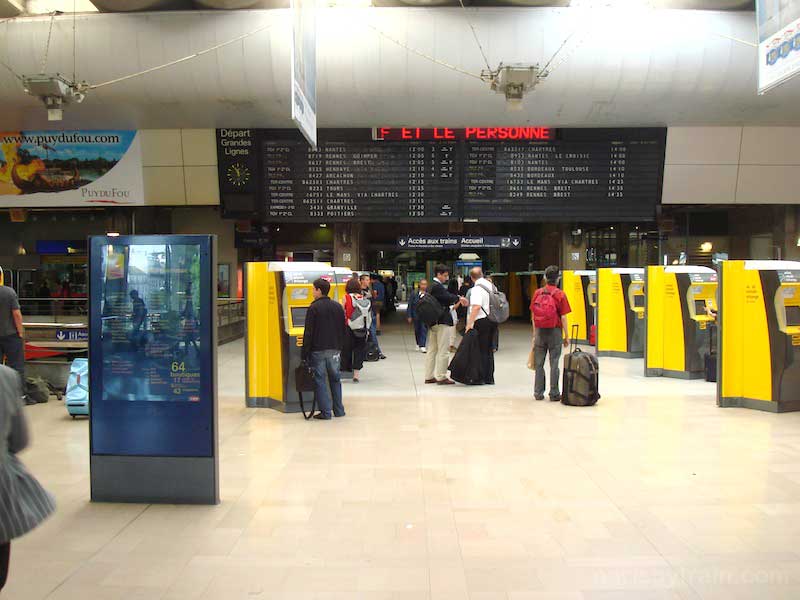
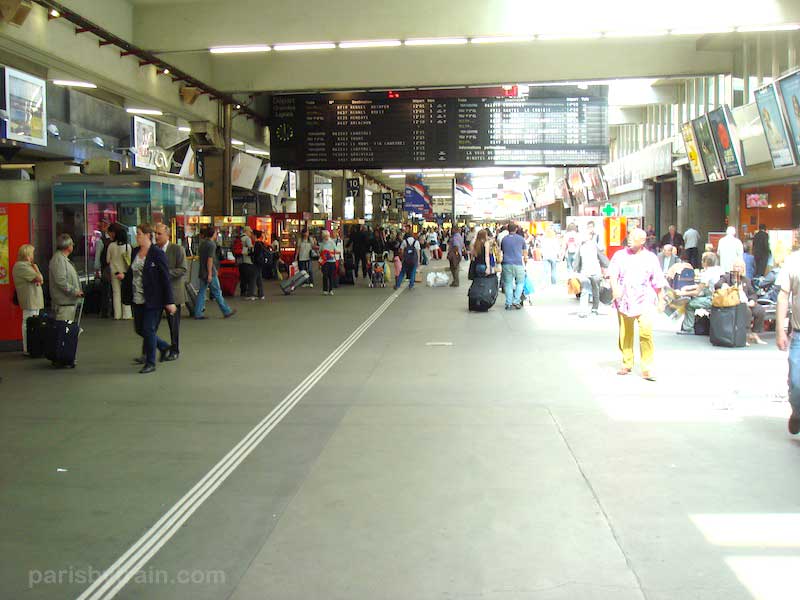
Above is another photo of the departures board from head-on.  Just below the board is a sign reading Access to Trains (”Access aux Trains”).  The short hall past the ticket machines leads into Hall Maine, where all the TGV, Ter and Transilien trains are parked at lanes (”voie”) 1 to 28, starting from the left (east).

Train Tickets

Looking left from above position, still on Level 2, we see signs directing travelers to the TGV ticket office as seen in the photo below:
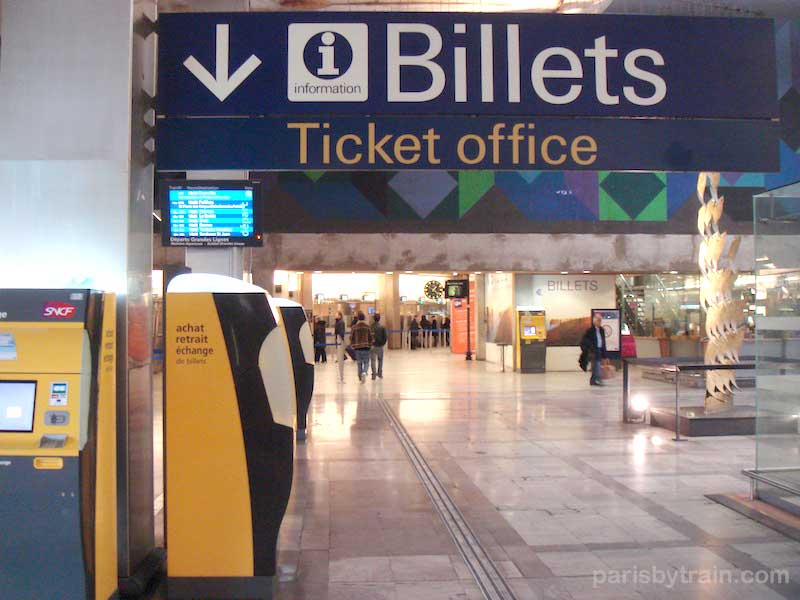
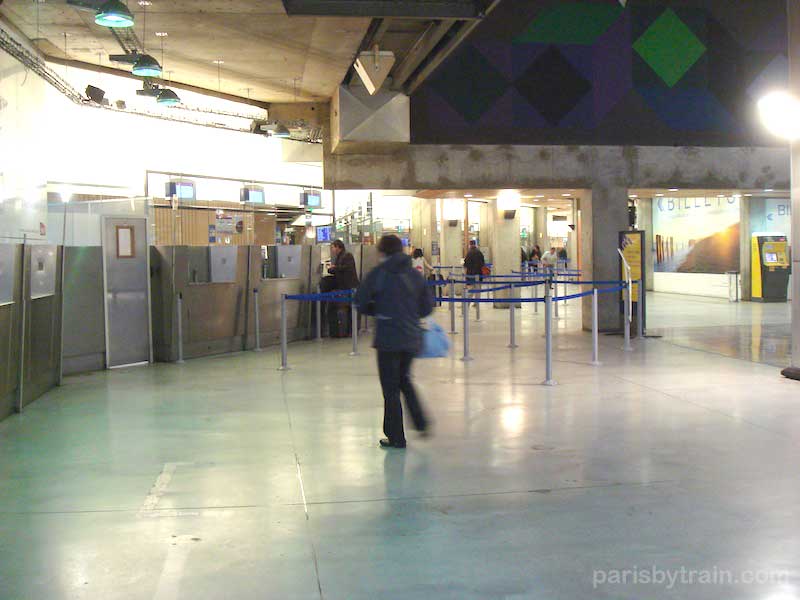
Moving closer to the ticket office we see that there are different types of ticket counters available to us (three in total). The first set of ticket counters to the extreme left sell TGV tickets and other non-high speed train tickets for immediate departures, i.e. train tickets for travel leaving in the next hour.  Here is a photo of that area:
Further to the right are ticket counters for Grandes Lignes train tickets which includes TGV, Ter, Téoz, Corail, Lunéa brand French trains which travel to other cities across France.  If you’re not in a rush to buy a ticket and hop on the next train, this is where you should buying your train tickets.

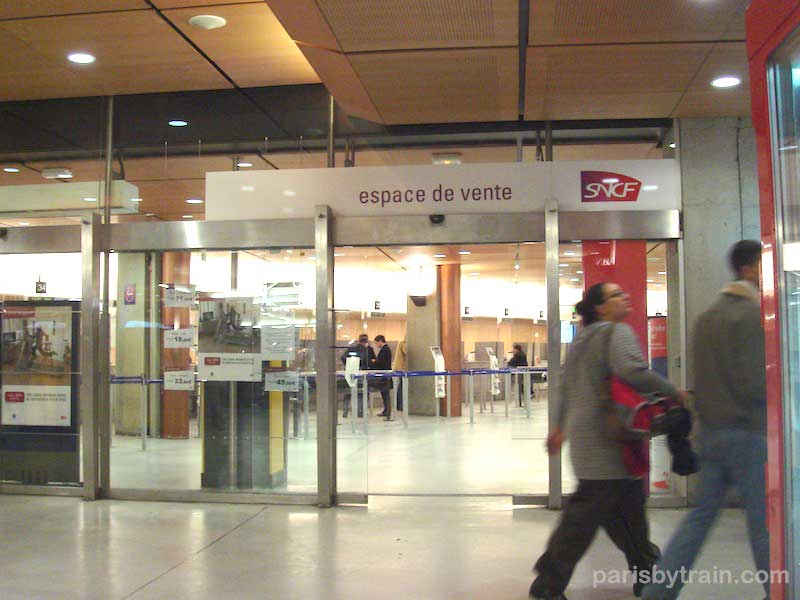
The final ticket office area is enclosed in glass and is marked Espace de Vente. This ticket office sells train tickets for international destinations such as Italy, Belgium, Netherlands and Germany.  Below is a photo of the International train ticketing office at Montparnasse:
Below is a map of Montparnasse Level 2 showing the layout of the train ticket office on the bottom left and its three counter areas: Réservations Internationales (International Train Reservations), Réservations Grandes Lignes (TGV, TER & other intercity trains within France), and Billets Départs Immédiats (Tickets for Immediate Depatures).
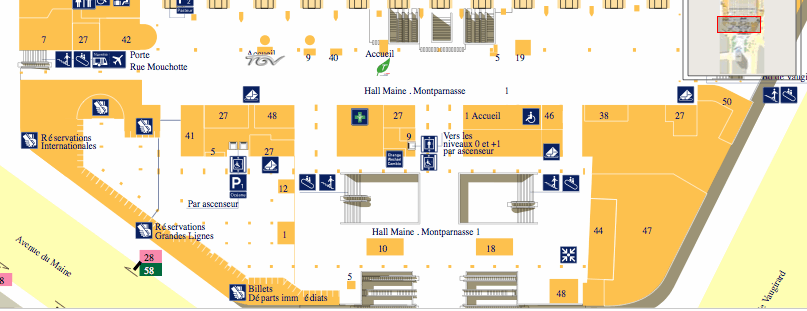
This Montparnasse map is courtesy of Gares en Mouvement.  Visit their site for a full version.

Montparnasse Train Departures & Arrivals Area

Let’s look at the train platforms (arrivals & departures) for TGV, Ter and other trains.  Here is an overhead map of the train lanes at Hall Maine which are can be seen in the pictures further below:
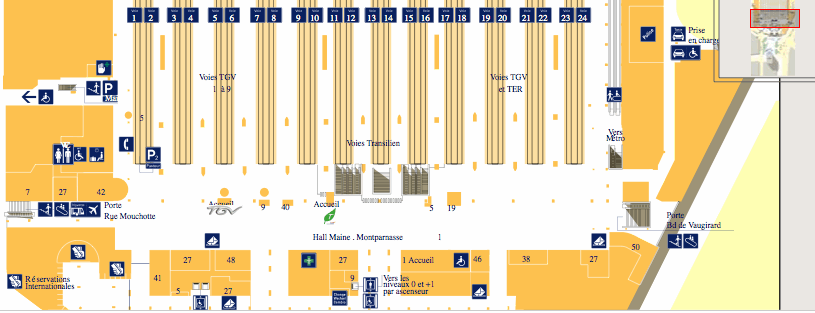
The picture below taken from the left end of Hall Maine, Level 2, where the lane numbers are low and climb as one moves further down the hall.  At the top center of the photo below is a large black departures board showing when trains are departing, their destinations and from which lanes.  The trains are parked on the left, starting with Lane 1 (Voie 1) and climb as you move further down the hall. The ticket counters described in the previous section are off to the right of this position (not visible in the photo).
Each of the lanes terminates with a column showing a lane number on the side. TGV lanes 1 - 9 are marked with a TGV insignia near the tops of the columns.
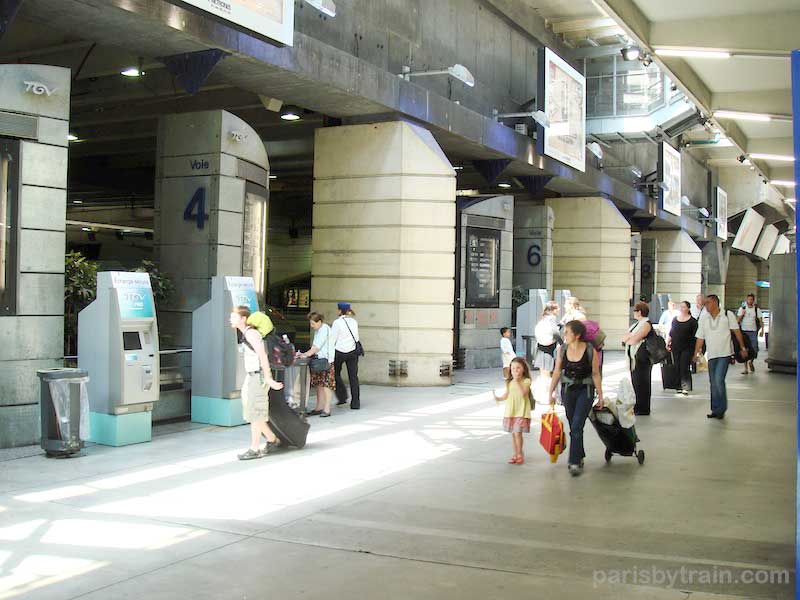
Ter, Transilien commuter trains and finally more TGV trains are parked between lanes 18 to 28.  On the front of each column marking the lane you’ll find the lane number (”Voie”) and train information including direction and stops along the way.

In the photo below, at the far end of Hall Maine you’ll notice that the train lanes stop at 24, yet there are 28 lanes in total at Gare Montparnasse.  On the far wall is a sign pointing to lanes 25 to 28, located diagonally to the left past lane 24. This area is also referred to as Montparnasse 3 or Gare Vaugirard.
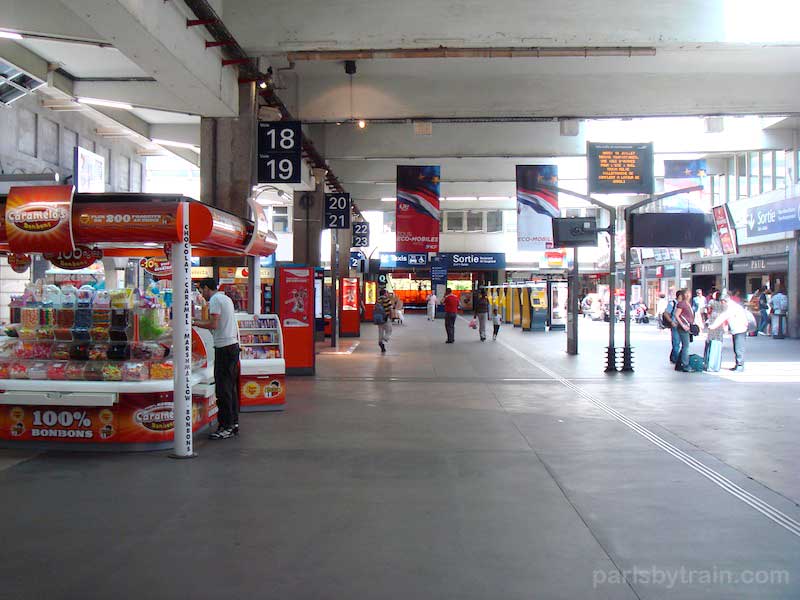
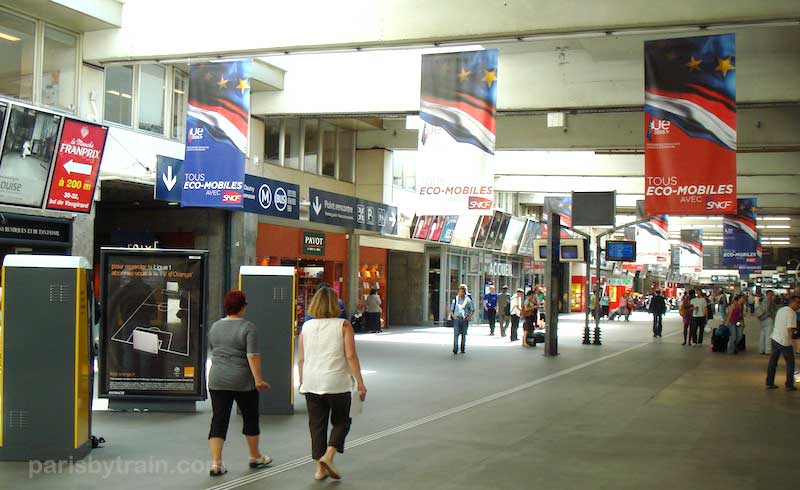
If you’re arriving at, rather than departing, Gare Montparnasse by TGV, Ter, or Transilien train and are looking to make a connection to the local transit options, follow the large blue overhead signs pointing towards buses and Metro lines located ahead and below at Street Level (Niveau 0) and Sublevel 1 (Niveau -1) (overhead signs in blue can be seen at center left of the above photo).
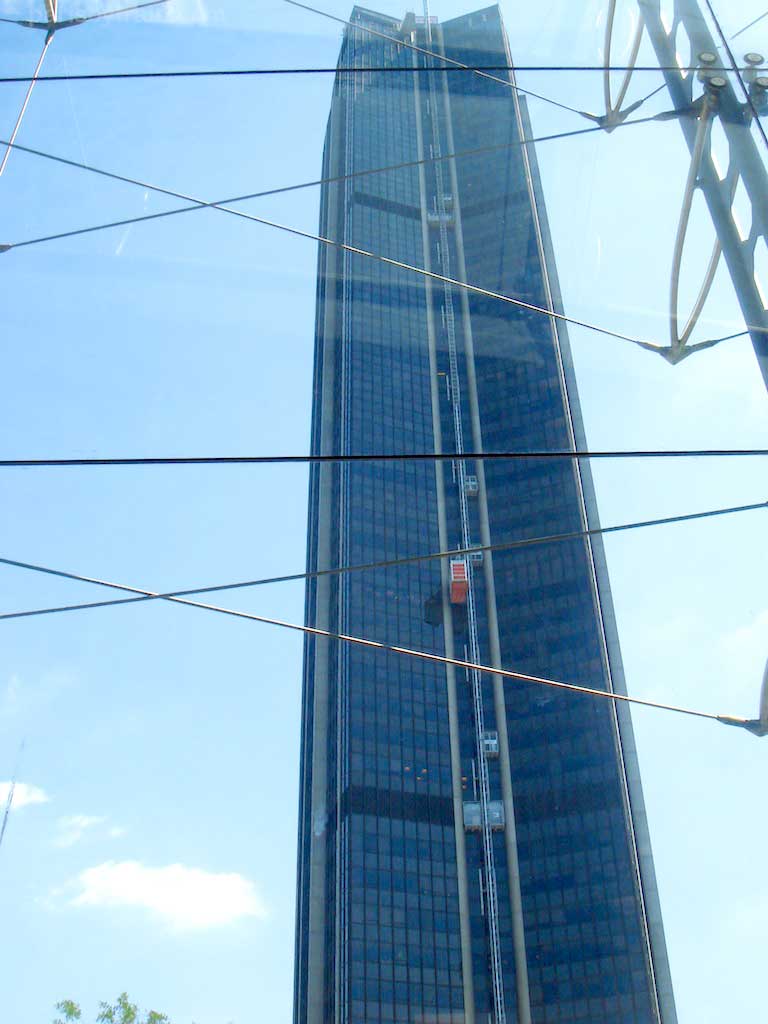
To help get your bearings after you’ve arrived and are still on Level 2, walking straight out from the main train lines will give you a view of Tower Montparnasse (Tour Montparnasse), which is very visible out the front window of Gare Montparnasse.  You are facing north east from this position.
Useful Links

Online map of Gare Montparnasse

Carte Orange

What is Carte Orange?

  • A weekly or monthly public transportation “pass” for Paris and the Ile-de-France region.
  • Exists in the form of a contactless smartcard known as a Pass Navigo (for residents) or a Pass Navigo Découverte (for non-residents). Formerly, Carte Orange was an actual paper
    card, orange in colour, with personal identification, paired with a coupon like ticket for use in turnstiles for access into fare-paid zones.
  • Price varies on zones (1 to 6) and duration purchased. (See a Paris Fare Zone map).
  • Valid for RER (regional express trains), Metro (subway), buses, trams, cable cars, and commuter trains.
    Weekly passes are valid from Monday start of services (approx. 5:30am) till Sunday evening last service (approx. 1:30am).
  • Monthly passes are valid from first till last day of the month.
  • No limit to quantity of voyages on public transportation system while the pass is valid.

Restrictions

  • Pass is non-transferable.
  • Pass requires bearer’s facial photo and name.
  • Carte Orange is not valid on Orlyval shuttle train to Orly Airport.

Buying Carte Orange

  • Before Carte Orange can be purchased, one must hold a physical pass card: either a Pass Navigo or a Pass Navigo Découverte.
  • Pass Navigo cards are available to individuals with a mailing address within the Ile-de-France. Applications can be made online via Navigo.fr or through letter mail paper application. Cards are delivered to the applicant’s mailing address.
  • Pass Navigo Découverte cards are available instantly to anyone for a €5 fee plus a 3cm x 2.5cm facial photograph to be used with the card. Available for purchase at all RATP / SNCF ticket windows at Metro stations and train stations.
  • With smart card in hand, Carte Orange can be purchased at most RATP (Paris Transit Authority) ticket windows within Metro, RER, bus stations, or at SNCF (French National Railway Company) “Billet Ile-de-France” ticket windows.
  • Carte Orange can also be purchased through automated vending machines (Billetterie Ile-de-France) within train stations and Metro/RER stations, which take coins and smart-chip based credit card/debit cards.
  • Weekly Carte Orange (hebdomodaire) is available for purchase from Sunday to Wednesday (close of service). Afterward, only next week’s Carte Orange is available for purchase from Friday (start of service) onward.
  • Monthly Carte Orange (mensuel) can be purchased for the current month up until the 19th day of the current month. From the 20th onwards, only next month’s carte orange is available for purchase.

How to use Carte Orange

On the Paris Metro & RER

  • After entering the confines of a metro station, approach turnstiles (reserved turnstiles may be used)
  • Hold the pass next to the purple circular card reader.
  • Wait for a chime sound.
  • Pass through the unlocked turnstiles.
  • The Pass Navigo card can only be used once every 5 minutes for the same turnstile or direction (prevents multi-person use).

On Buses and Trams

  • Enter at either the front or back doors.
  • Once on board, find the card reader placed on a pole near the entrance.  Validate the pass by holding the card close to the purple swirl design on its face. Wait till a “chime” sounds and a green light appears at top.

On Transilien/Ter commuter trains

  • Validate the pass using standalone card readers throughout station or platform. (Not strictly necessary, but requested by SNCF).
  • Show pass to controllers as requested for verification by portable card reading machines.

(Metro/Bus card reader photos courtesy of RATP)

Here are ten ways to ride the Paris Metro like a local (or better).

  1. Plan your route. Before making a trip, use a Metro map and the official RATP Paris Metro route planner to find the shortest route with the least number of line changes.  Station to station a Metro train will take just over a minute. Making connections will cost you about 3 minutes at small interchanges with few intersecting lines and up to fifteen minutes at mega stations Chatelet Les Halles, Gare du Nord, Gare Montparnasse, Saint-Lazare.  These stations are enormous, sprawling, multi-level, and likely confusing (especially Chatelet Les Halles). You could be walking up to a kilometer to reach the next train platform. If you’re changing trains more than twice, search for a more direct route.
  2. Don’t wait till Monday morning or the first day of the month to buy your Metro ticket t+ or Carte Orange for the week.  The lineups for both vending machines and ticket windows are extremely long on these particular days, since Carte Orange expires on Sunday evening / last day of the month.  Thus, an unusually large number of people will be renewing their pass.
  3. Take the RER if you can, even if it means back tracking on the Metro.  With far fewer stops and higher speed, the RER is almost always faster than the Metro.  Use it as much as possible.
  4. At rush hour on the station platform, walk to the far end, furthest away from the entrance stairwell.  People tend to bunch up just next to the platform entrance, reducing your chance of getting on the train.  You’ll also get last second “jumpers” who push themselves onto the last metro car as the doors are about to close, squishing everyone else already on the over-packed car.
  5. Time flies: Most platforms have overhead signs showing minutes till the next train.  These are hardly atomic clocks.  2 minutes can mean immediate arrival or actually 6 minutes.  Don’t wander off in the meantime.
  6. Choose the best train car.  Many people stand at the edge of the platform near the rails to be closer to a car door when the train arrives thinking this will guarantee they get on. This is untrue.  Trains often arrive with cars which are full and no one is descending. If you happen to be waiting at the doorstep of such a train car, you’re not getting on. Furthermore, when you turn around to go to the next train door, you’re no longer at the head of the line, you’re at the rear, as everyone else behind you has turned toward the next train car as well, and you’re behind them.  By standing back, you can survey the train cars as they pass, allowing you to quickly move to the one that is not overly full and where there are people descending.  Stand back as the train arrives to watch multiple doors. Some train cars will have many people descending, some none at all.  Your best chance of getting on a busy Metro train is with a car somewhere in between these two extremes.  Standing back from the fray allows you to see the action from afar and choose the best train car.
  7. Take off your backpack & keep it near your feet/between your legs. You’ll take the personal space (at a premium on the Metro) of two people with it on your back.  It’s bad form, screams “ignorant tourist” and is more prone to having uninvited “inspections” for wallets and other valuables (not common, but possible).
  8. During rush hour, stand, don’t use the folding seats near the train doors, which allows more people to be crammed into the train car, a national past time in Paris.
  9. Prepare for takeoff: Make your way to the door (carefully) before the train arrives at your station. If this is not possible at least make motions that you’re getting off at the next stop.  Everyone reads that body language and will prepare to get out of your way when it’s time.  This allows you to alight quickly so that others have time to enter the train before it departs.
  10. Wash your hands after your journey. The amount of other people’s lives on handles and poles on a Metro train would make the monkey in Outbreak shudder.

(Photo by jmanners)

Here is a panoramic photo of Marne La Vallée station and DisneyLand Paris, accessible by RER A train from central Paris stations Gare de Lyon and Chatelet Les Halles. (Click photo for larger version). Paris Disneyland is also accessible by TGV train from CDG to Disney, taking only 10 minutes to make the voyage.

Voici un photo panoramique de Gare de Marne La Valléé - Chessy et Parc Disneyland accessible par RER A de plusiers stations à Paris: Gare de Lyon, Châtelet Les Halles.  (Cliquez la photo pour l’agrandir). Parc Disneyland est aussi accessible par TGV de l’Aéroport Charles de Gaulle à Disney qui prend juste 10 minutes pour le voyage.

Euro Disney Save 15% by booking online - Disneyland Paris

Here are photo instructions on taking a train from Roissy Charles de Gaulle Airport Terminal 1 to central Paris. Click on photos to see larger versions.

CDG Terminal 1 to Paris

If you’re arriving at CDG Terminal 1, you’ll first need to take the CDGVAL shuttle train to Terminal 3/Roissypole (center of map) to catch the RER B train to Paris.

Follow CDGVAL signs posted throughout Terminal 1 that will look like the following:

The CDGVAL shuttle train travels from Terminal 1 to Terminal 3/Roissypole then to Terminal 2 as shown on this line map:

While on the CDGVAL shuttle, keep in mind that:

  1. Terminal 3/Roissypole is the second stop which is before Terminal 2.
  2. The shuttle will stop at parking garage Pr before arriving at Terminal 3/Roissypole.


Upon arrival at Terminal 3/Roissypole, you will enter a large concrete atrium show here:


When exiting the CDGVAL stop at Terminal 3/Roissypole, turn to your right and walk towards a series of blue ticket vending machines and several ticket windows behind an overhead sign for RER B “Paris par train / Paris by train”:

From here you can purchase single train tickets for Paris from the blue vending machines (Billetterie Ile-de-France) for €8,40 one way. These tickets are known as “Billets Ile-de-France“.

Keep in mind that these vending machines do not sell pass cards Pass Navigo Decouverte / Paris Visite and only take coins or smart-chip enabled credit cards. If your credit card is from North America, most likely it will not have a smart-chip and will not work with these machines.

To purchase a Pass Navigo Decouverte or Paris Visit Card (public transportation passes) you must visit the ticket window immediately in front of these machines (off to the right side of the photo, not visible). If you already have a Pass Navigo / Pass Navigo Decouverte, you can recharge your card with Carte Orange from the blue Billetterie machines by inserting your pass into the purple Navigo slot and following the prompts.  Beware of the purchase restriction schedule on the Pass Navigo.

After purchasing your tickets or passes, you can verify when the next RER B train is scheduled to depart CDG by checking the overhead display screens. The display screen on the right shows RER B trains “To Paris” (”Vers Paris”).

RER B trains on this screen stop at all the Paris stations regardless of the name under the Destination column. The Destination names are the terminus stations for the several RER B train line branches and are used to specify the direction each train is traveling. A complete list of departure times from Terminal 1 RER B station towards Paris is available at the bottom of this article.

Insert (and then retrieve) your ticket or scan your pass at the turnstiles and descend onto the RER B train platform. Signs will note that “Tous les trains vont à Paris” (”All trains go to Paris”).

Once the train arrives, the train doors may not open automatically. Press the small metallic or rubberized button on the door to open the train doors.

Remember to keep your ticket or passes handy as “controllers” (”ticket checkers”) frequent these trains.

Travel time to the first major Paris station: Gare du Nord, is roughly 25 minutes. Stations served after that will be Chatelet Les Halles, St. Michel-Notre Dame, Luxembourg, Port Royal, Denfert Rochereau and Cité Universitaire.

If you need to transfer to a Paris Metro train or a different RER train to arrive at your final destination, you may use your ticket for making the transfer; You do not have to purchase another ticket for the Paris Metro or RER within Paris Zone 1. If you need to transfer to a bus or tram, you will need to purchase a new Ticket t+ as transfers from Metro/RER to buses/trams are not allowed.

Useful Links

CDG Airport Map

CDG to Euro Disney by TGV

The following train timetables show depature times of RER B trains leaving CDG Terminal 1 towards Paris.  (Ignore the second pages, which show Terminal 1 to Terminal 2 departure times).

RER B Train Schedule (departure times) CDG Terminal 1 to Paris Monday to Friday (except holidays)

RER B Train Schedule (departure times) CDG Terminal 1 to Paris Saturday, Sunday and holidays

To purchase £69 round trip Eurostar train tickets from Paris to London (or London to Paris):

1. Go to Eurostar.com and click on the Eurostar Tickets from £55 return image (note that the image will have likely changed as GBP prices have increased to £69 minimum as of December 15, 2009):

Cheap Eurostar Tickets

2. Then click on the Arc de Triomphe entitled: Paris from £69:

Eurostar Paris £59

3. Select departure/return dates with High Availability (bright yellow colour) which are usually 30 or more days from today (click on the Next link, top right corner of calendar to move to the next month):

Then click on “Search“.

If you get a red error message like the following:

Simply press the Back button on your browser and search a day before or after your preferred travel date.  Remember that High Availability days are nearly guaranteed to be available for the £69 return ticket price.  Medium and Low availability days will be more expensive.

In general the first High Availability day will be at least 30 days from now.  Thus, if you can book your Eurostar at least 30 days in advance and you’ll get the cheapest Eurostar fare available.

This is a detailed guide of how to buy Eurostar tickets and how to take the Eurostar high speed train from Paris to London. Tickets for the Eurostar start at £69 return and travel time between central Paris (Gare du Nord) to central London (St Pancras/King’s Cross) is 2 hours 15 minutes.

Overview

Line => Eurostar

Direction => London - St. Pancras

Departure Station => Paris - Gare du Nord

Arrival Station => London - King’s Cross / St. Pancras International

Timetable/Schedule => First Train: 05:25 / Last Train: 20:05
Click to download full Eurostar Timetables Schedules (PDF)

Ticket Prices => From £69 return from Eurostar.com / RailEurope.com

Tickets and Schedules

Eurostar Schedule & Ticket SearchThe best way to search and buy Eurostar tickets is directly from www.eurostar.com. The advantage of buying tickets directly from Eurostar.com is that they offer free home delivery of tickets, whereas resellers such as Rail Europe may charge a fee depending on your whereabouts. For example, Rail Europe charges $18usd for ticket delivery to a US based address.

You can choose to pick-up or collect your tickets from automated ticket vending machines at your departure train station, but you must use a smart-chip credit card to do so (most European credit/debit cards are enabled with smart chips and pin code protection).

If you’re coming from North America, most likely your credit card will not have a smart chip and will not work with these machines.  In this case, your best bet is to select Home Delivery.

The Eurostar train leaves Paris from Gare du Nord, one of the six major train stations in central Paris (see the Gare du Nord photo tour for more information).  Check-in for the Eurostar train to London is done through a special upper level at Gare du Nord (Level 1 or Niveau 1 in French), separated from the rest of the station, where all Eurostar travelers must pass through both French and British passport control before boarding the train.  (This is due to England’s partial implementation of the Schengen Agreement amongst European Union member countries).

Check-in procedures from the Eurostar starts with scanning your ticket through a turnstile machine.  Keep the ticket printed side up (magnetic stripe facing down) when inserting your ticket. The ticket can be inserted at either end.  The machine will eject your ticket out the top, whereupon you should take your ticket back and keep it for the rest of your journey. The turnstile gates will slowly open and you can then pass through onto passport control.

For passengers not holding a European Union passport, you’ll have to complete a declaration card for British Immigration control.  This is just like landing cards you would fill out for overseas flights, asking the normal questions: name, date of birth, country of birth, where you’re staying in England.

After passing through French and British immigration control you’ll need to pass a security screening where your bags are scanned and you walk through a metal detector.

Finally you’ll arrive in the Eurostar waiting lounge.  The first waiting lounge is for regular Eurostar ticket holders, with tickets for train cars (”voiture”) 6 to 18.  A second smaller waiting lounge can be found further down the hall and is reserved for Eurostar Business and Premier clients, usually seated in train cars 1 to 5.

Boarding for the Eurostar train starts 20 minutes before departure.  An employee will check your Eurostar ticket once more before allowing you to descend onto the dedicated Eurostar platforms at the western end of Gare du Nord.  Immediately after this last ticket check, you can descend onto the train platform using either the moving sidewalk to your left, or via the stairs to your right.  Often the stairs will be completely empty while the slow moving sidewalk will be full with a group of people waiting to descend.  You might want to simply take the stairs if you’re not carrying much luggage.

To find where you’re seated on the train look at the center of your Eurostar ticket where there will be a car number (”Voit”, short for “Voiture” in French, meaning “Car”) and seat number printed, such as in in the following photo (showing Voit 17 seat 23).

To find your designated car along the train, look at the digital display screens located at the end of each train car, next to its entrance door.  This screen will show a large car number from 1 to 18 along with the destination of the train.  In the photo below we see train car number 17 and the destination of the Eurostar (this photo was taken for a trip going to Paris rather than going to London, stopping at Ashford International on its way).

When taking a Eurostar train from Paris to London, it’s common for the Eurostar to stop at Ebbsfleet (and sometimes Ashford) station 15 minutes before arrival at London St. Pancras / King’s Cross. Don’t mistakenly get off the train too early at these dark, uncovered stations outside of London.  St. Pancras International train station on the other hand is well lit, enormous, with plenty of signage and the Eurostar will park itself underneath the covered area.

After arrival, you’ll make your way towards the atrium area with its gigantic clock on the center of the wall.  You’ll descend down a moving walkway towards the customs area where you will pass British customs officers randomly screening passengers.  After that, your options for ground transportation include London Underground Tube (subway) via King’s Cross station, connected underneath St. Pancras, or light rail via St. Pancras station.  See the London public transportation site, tfl.gov.uk, for more information on subways, buses and trains within London.

Useful Links

Eurostar

Transport for London

Gare du Nord photo tour

This is a guide on how to read Paris RER train schedules, which can appear complex at first glance.

We’ll learn how to read an RER timetable through an example trip: Paris to Euro Disney by RER A Train.

Things you’ll need to know before you start:

  1. Your Destination RER train station (Marne La Vallée-Chessy)
  2. Your Departure RER train station (example: Gare de Lyon)
  3. The terminus (last) station along the RER train line, in the direction you’re traveling.

To see all RER train lines use an RER train map. To get detailed information on a single RER line, view its corresponding RER line map, which can help you find a departure station in Paris (Zone 1), the destination station, and the line branch/direction you need.  RER Schedules can be found on the RER Schedules category page.

Step 1 - Find Destination Station: On the left hand side of schedule / timetable will be stations along the RER train line. Start by finding the station that you wish to arrive at, your destination station. In this example, we want to go to Marne la Vallee, the station for Euro Disney along the RER A train line.

Step 2 - Find Desired Time of Arrival: On the row for your destination station, trace your finger along the row until you find the time you want to arrive at. Subsequent pages will have later times, so flip through the schedule book to find later arrival times.  If the time you’re looking for isn’t shown on the current page, view subsequent pages, keeping your focus on the row of your destination station, in this example, it’s Marne la Vallee, which is easy since it’s the last row/station along the RER A line.  Once you’ve found the time you wish to arrive at we can now find when the train leaves and from which stations.  Note that all times are listed in 24 hour clock. Thus 1731 would be 5:31pm in the afternoon.  Morning times are shown without a leading zero, so 6:55am would be shown as 655.

Step 3 - Find Departure Station & Time: Having found your desired arrival time, we can now check when the train departs and from which Paris stations.  Each column on a RER timetable represents a train running along the line, albeit at different times.  Moving to the right across columns shows trains that depart later in the day.  Not all trains stop at all stations along the line, thus you’ll see large gaps in the schedule, which indicates a branch or stations of the RER line that is skipped by the train.

From your chosen arrival time, trace your finger up the column till it crosses the station row that you want to depart from.  Paris stations are near the middle of the sheet. The major RER A stations in central Paris are: Charles de Gaulle-Etoile, Auber, Chatelet Les Halles, Gare de Lyon, and Nation. Here we move up the column till we reach a 6:54am departure which coincides with station Gare de Lyon.  Thus we can take an RER A train, in direction Marne La Vallée, leaving from Gare de Lyon at 6:54am, arriving at 7:30am at station Marne La Vallée-Chessy, the closest station to Euro Disney.

The following PDF file, How to Read Paris RER Train Schedules, is the same guide on how to read RER train schedules, with Paris to Euro Disney as the example trip along the RER A line.

(cliquez ici pour français France Flag)

This article explains how to take a RER A train from Paris to Disneyland Paris. If you’re going from Charles de Gaulle airport to Parc Disneyland, you can take either a TGV train direct from CDG to Disney (Marne la Vallée) or first take the RER B train to Paris then at station Chatelet Les Halles, switch to the RER A train line towards Marne La Vallée.

Euro Disney Note: You can save 15% on DisneyLand Paris tickets by buying before you arrive.

Overview

Line => RER A (Red)

Direction => Marne-la-Vallée (RER line A4)

Departure Stations => Charles de Gaulle Etoile, Auber, Chatelet Les Halles, Gare de Lyon, Nation

Arrival Station => Marne-la-Vallée — Chessy

Map => Full RER train network map (PDF)

Price => €6,45 (Zone 1 -> Zone 5)

Passes Accepted => Paris Visite Card (6 Zone), Pass Navigo (Decouverte)/Carte Orange 5 Zone, Ticket Mobilis 5 Zone

Travel Time => 39-45 minutes

First Train / Last Train (Gare de Lyon - Disney) => 05:22 / 00:39

Frequency of trains => approx. every 15 min. (9 minutes to 30 minutes between trains)

Full Schedule => RER Train Schedule/Timetable

Details

RER Stations


RER A city trains travel from central Paris to Disneyland throughout the day at roughly 15 minute intervals from five large central Paris RER A Stations: Charles de Gaulle Etoile (at Arc de Triomphe), Auber (at Galeries Lafayette shopping center), Chatelet Les Halles (massive underground shopping centre and largest underground/subway station in the world), Gare de Lyon (largest Paris train station), and Nation.

Tickets & Passes - RER Paris to DisneyLand Paris

A single one way ticket, a billet Ile-de-France, from central Paris to Disney costs €6,45 (as of July 1, 2008). You can buy these tickets from any metro or RER station ticket window or from the automated ticket vending machines (using coins or smart-chip enabled credit cards) within stations. You can start your journey from any Metro / RER station within central Paris (Zone 1) using this one ticket and simply transfer to the RER A line if you’re not already on it. You don’t need to buy a separate ticket just for the metro portion of your trip. The normal metro ticket t+ will not work for this trip since Marne la Vallée / Parc Disney is in Zone 5.

The following passes are accepted for traveling from Paris to DisneyLand:

Inside an RER Station

From inside any of the above mentioned Paris RER stations, you’ll want to take RER A in direction Marne-la-Vallée, but keep in mind that the direction may also read Boissy-St-Léger such as in the photo below.

You’ll find station panels and signs similar to the one above at any of the above RER A stations. Follow these signs to the correct RER A train platforms. At certain stations, Chatelet Les Halles and Gare de Lyon for example, these RER train signs & panels will lead you to a single central platform with RER trains running along either side in opposite directions. To avoid confusion as to which side is the correct direction look up at the RER station stop panels hanging above each side of the train platform such as the one shown here:

RER A Station Panel Direction Poissy, Cergy-Le Haut

Each station along the line will be shown on these panels, but the next train to arrive will only stop at stations names lit with a yellow square (the left half in the previous photo). Thus, these panels serve two purposes:

  1. to indicate that you’re on the correct side of the platform: if you see your arrival station on the panel, you’re at least on the correct side of the platform. In this case you’d want to see Marne La Vallée - Chessy as one of the stations.
  2. to indicate whether the next train will stop at your desired station. If Marne La Vallée - Chessy is lit with a yellow square, take the train. If not, wait for a train that will stop at Marne La Vallée/Parc Disney.

Once on board a RER A train to DisneyLand Paris, remember to keep your ticket handy throughout your trip as you may be asked to show it to ticket checkers, known as controllers in France. If you fail to produce a valid ticket the controller will charge you a fine somewhere in the range of €35 payable on the spot through credit or debit card. And even though ticket vending machines don’t take non-smart chip credit cards, the mobile credit card swipe machines these controllers carry, definitely do. At the end of your trip you’ll also need your ticket or pass to exit through the turnstiles when you arrive at Marne La Vallée / Disney.

This is the Marne La Vallée train platform at DisneyLand Paris when you arrive:

Once you exit the RER A train make your way up the escalator or stairs in the direction of the Sortie signs. This leads you to the exit (and entry) turnstiles for the RER trains as show in the following photo:

Using your billet Ile-de-France in the turnstiles allows you to pass through into the main section of the station which has an information booth, ticket window, and various shops selling newspapers/magazines and snacks.

After exiting Marne La Vallée–Chessy station, you’ll notice the motif of the station itself is Disney-like with its castle like spires.

Here’s a panoramic photo of Marne La Vallée–Chessy RER/TGV station amongst some attractions at DisneyLand Paris.

When it’s time to return to Paris, you’ll be making this trip in reverse. Within Marne La Vallée–Chessy train station, you’ll need to again purchase a Billet Ile-de-France to Paris (6,45€) either from a ticket vending machine or from the ticket window, pass through the turnstiles, and descend down onto the RER A train platform. The platform will be well marked with a sign indicating which train will depart next for Paris:

Have a great Disney visit.

Useful Links

Euro Disney Save 15% by booking online - Disneyland Paris

RER Train Line Maps

RER Train Line MapsRER Train Line Map

The following RER Train Line maps are specific to a single RER Train line, A, B, C, D, or E.

Each RER Line map shows:

  • Stations along the RER line
  • Branches & Terminus (last) stations for each branch, used to specify direction of travel for RER trains along their platforms within stations
  • Interchanges or Connections to Paris Metro lines
  • Connections to other RER train lines
  • Transfers to TGV Trains, Transilien/Ter commuter train lines at large Paris train stations (known as “Gare” in French). This includes Gare du Nord, Gare de l’Est, Gare de Lyon, Gare de Austerlitz, Gare de Montparnasse, Gare St. Lazare.
  • Zones for Carte Orange / Pass Navigo / Paris Visite / Mobilis tickets and passes
  • Handicap accessibility at stations
  • Famous attractions near stations

These maps can be found on all RER train cars just above their doors.

RER A Train Line Map

RER B Train Line Map

RER C Train Line Map

RER D Train Line Map

RER E Train Line Map

Paris and the surrounding area is divided into 6 concentric zones for use in pricing public transportation passes.  Travel into the 6th and farthest zone is the most expensive, while zones 1-2, central Paris, are the least expensive.  Examples of popular destinations and their zones: Chateau Versailles & Orly Airport - Zone 4, CDG Airport & Euro Disneyland - Zone 5, Fontainebleau - Zone 6.

This Paris Transportation Zone Map (PDF) displays Fare Zones 1 to 6 which apply to:

What’s visible on the Zones map:

  • Fare Zones (”Zones Tarifaires”) 1 through 6
  • RER A, RER B, RER C, D, E train lines
  • RER & Transilien train network in Ile-de-France (administrative region around Paris)
  • Station names along all RER/Translien train lines
  • Connections (”Correspondances”) and transfer possible between different RER, Transilien, and RER to Transilien trains
  • Shuttle bus (”navettes bus”) from RER C station: Pont de Rungis and Orly Airport
  • Orlyval train to Paris-Orly Airport between RER B station: Antony and Orly West / Orly South airport terminals, which requires a special fare (”tarification spéciale”)
  • Major tourist sites (”Sites touristiques”) accessible from certain stations

(Zone map courtesy of RATP)

RER C Train Map

This RER C Train Map shows:

  • All stations along each RER C branch (C1 - C7)
  • Interchanges with Metro Lines / RER Lines
  • Famous Sites and Attractions at stations on RER C
  • Zone regions (Zone 1 to Zone 6)


Downloadable RER C Line Map (PDF)

Popular Destinations

Along RER C (with station names in brackets) in and around Paris:

More Information

RER Train Map (RER A, B, C, D, E) (PDF)

Maps on Paris by Train

Grace à Google Translate.  Il y a un widget disponible sur la rubrique gauche où vous pouvez changer le langue de la page instantement en plusiers langues, français par exemple.  Et, le traduction ce n’est pas mal du tout. Loin de parfait (comme mon français, evidemment), mais, pour la plupart, il marche.

Google.. vous ne cessez jamais de me surprendre.

Paris by Train Forum

Paris by Train forum is now open for questions, answers, general discussion about all things public transportation in Paris.

Have a question on Paris Train Schedules?

How to get to your hotel in Paris?

Where are the best baguettes in Paris?

Ask your question on the Paris by Train forums!

Overview

  • Costs €1,60 per journey (with an individual Ticket t+)
  • Children 4-10, cost is €0,80. Children 3 and under ride for free.
  • Passes Accepted => Pass Navigo, Navigo Découverte, Paris Visite Card, Ticket Mobilis
  • First trains leave terminus stations at 05:30
  • Last trains leave terminus at 00:40, 01:40 on Fridays, Saturdays and nights before holidays

Paris Metro

The Parisian subway is known as the Metro, short for “chemin de fer Métropolitain” [metropolitan railway].  The network of underground rail lines has 245 stations scattered throughout central Paris’ 20 “arrondissements” [districts].

Tickets for the Paris Metro are purchased from blue or green “billetteries” [ticket vending machines] or from “guichets” [manned ticket windows] within stations. The current price (July 2008) for a single ticket known as a “Ticket t+” is €1,60. Tickets can also be purchased as a book of ten or twenty, known as a “carnet” [booklet], for a slight discount (booklet of ten Ticket t+ is €11,40 or €1,14 each).

Paris Metro Ticket t+

During your journey, keep your ticket with you until you arrive at your destination station and pass through the exit gates or turnstiles.  “Controleurs” [ticket inspectors] may stop you at any point during your journey to ask to see a valid ticket or pass.  Failure to provide a valid fare will result in a fine of €35, payable on the spot through credit card.

Paris Metro stations are mostly located underground with a few above ground due to local geography. Entry into the Metro stations is free up until the turnstiles which mark the area from which you must have a valid transportation ticket or pass. Some station entrances are unmanned, having no ticket window nor ticket vending machines, only turnstiles which accept tickets and smart card passes (Pass Navigo) for entry.

Metro lines are numbered from 1 to 14, each a different color, with two “bis” [b or secondary] lines making 16 in total.

Each Metro line has two (or more) terminus stations. These end-of-line stations are used to note the direction the train is traveling. Each Metro line platform within a station will be marked with the line number and the direction the trains will travel from that platform.

Signs within Paris Metro stations mark the way to train platforms on a given line, in a given direction. Metro lines are signified by the letter M within a circle.There are several Metro stations that serve multiple lines in various directions. This causes some stations to have several vertical levels accessible sometimes only by stairs, but often with escalators and sometimes with elevators for extremely deep stations.

As you make you way toward the line platforms within a station, stairs often descend or ascend onto the either side of the rails.  Each stairwell is often marked with a detailed Metro line sign showing number, direction, and stations that will be visited as the train travels toward the terminus.

(photo by roboppy)

Exits from Metro stations are marked by blue “sortie” [exit] signs and often note the street or area they give access to.

(photo by kygp)

Stations often have several exits leading out to various streets and pathways.  There is often a map provided within the station, outside of the ticketed turnstile area, but still within the station, showing all exits in relation to above ground streets and establishments.

Links

Paris Metro Google Knol

Paris Metro Line Schedule/Timetable with frequency and neighborhood maps for stations

More Metro photos & information at nycsubway.org