paris metro

You are currently browsing articles tagged paris metro.

Metro vs. RER

The Paris Metro vs. the Paris RER… what’s the difference?

The Metro isParis Metro symbol large

  • the Métropolitan chemin de fer (Metropolitan railway)
  • a subway/tube/underground train system
  • 16 lines, 1 through 14 plus two short secondary lines (3bis and 7bis) Paris Metro Line Numbers
  • just central Paris (see Metro map)
  • short distances between stations
  • one single fare zone
  • unscheduled service
  • mostly underground (subway/tube like)

RER SignThe RER is

  • the Réseau Express Régionale (Regional Express Network)
  • a commuter train system
  • 5 lines, RER A through E
  • central Paris plus much of Ile-de-France (see RER line map)
  • used interchangeably with the Metro in central Paris
  • faster than the Metro, with fewer stops & greater distances between stations
  • separated into fare zones 1 - 6
  • scheduled service (see RER schedules)
  • mostly above ground, except within central Paris

Resources

More information on the Paris Metro (Google Knol)

Metro Tickets (Ticket t+)

RER Tickets (Billet Ile-de-France)

(RER sign photo by Gregory Deryckère)

This is a step-by-step visual guide to ticket vending machines for the Paris Metro, Bus, Tram and RER.

In the above photo we see a Paris Transit Authority ticket vending machine.  You’ll often find these machines just beside manned Metro ticket windows.  At large Metro stations such as Chatelet Les Halles or Gare de Lyon you’ll find these machines placed throughout the station, usually embedded into walls.

Machine Layout

Let’s analyze the layout of the machine clockwise from the red button.

The red button is the “No” or “Cancel” button.  When you’ve taken a wrong step, made an erroneous choice, press this button to go “back” or to answer “No” to a question.

The large display screen is not a touch screen, unlike Billetterie Ile-de-France ticket machines.  To make choices on the screen, we use the rollbar located directly beneath the screen.

On the right, mostly cut-off from my poor picture taking, is the debit card slot, with a pin pad just beneath it.  These machines accept debit cards, but not credit cards, and also euro coins through a slot, not visible in the picture.  Further right, again, not visible (sorry), is a purple Navigo pass card slot. Pass Navigo and Pass Navigo Decouverte cards can be loaded or charged with Carte Orange at these machines.  Remember to remove the plastic protective cover from your card (if your card has one) before trying to insert the card.

Below that we have the green “Yes” or “Accept” button used to make selections.

Below the green Validez button is a ticket delivery slot, where bought tickets and receipts will be delivered upon completion of a purchase.

To the left of the Yes button we have the infamous roll bar.  Rolling this bar moves the selection “cursor” on the video screen.  Rolling this bar up with your hand moves to the next item “up” from the current position. Rolling the bar down, scrolls the highlighted item to the next item down on the screen.  To make a selection, press the green Validez (”Validate”) button.

Start / Welcome Screen

Let’s analyze what we see on the start screen, what you’ll see when you first arrive at the machine.

At the top left corner we see the RATP logo and what station you’re currently at (Chatelet Les Halles) along with which fare zone you’re in (zone 1). At the top right we have the current date and time.  You’ll notice that there is no language choice on this starting screen, but there will be one on the next page.

The Blue rectangle is the currently selected item or “cursor”. Upon start, the item selected is “Tournez le rouleau, puis appuyez sur valider” which in English is “Turn the rollbar, then push Validate”.

The starting screen has two selections:

  1. Buy tickets, coupons (”Acheter des tickets, coupons”)
  2. Recharge a Pass Navigo with Carte Orange (”Recharger un passe Navigo“)

Rolling the bar upwards will move the blue “highlight cursor” to “Acheter des tickets, coupons”. Pressing the Green “Validez” button will select that item and bring you to the next screen.

Buying Tickets

To buy a Paris Metro ticket, also good for the bus or tram, roll the bar upwards to highlight “Acheter des tickets, coupons” then press the green button.

On this next screen we have four selections, the bottommost being language choices for this machine (”English, Español, Deutsch, Italiano”).  I did not make a language selection, so the rest of the screens are still in French.

First choice (already highlighted in blue) is Ticket t+ for the Metro, Bus and Tram in Paris, Second class (”2e classe”), Full Price (”Plein Tarif”).  These tickets are always Second Class, since First Class Metro cars no longer exist.  Full Price tickets means Adult Price, which is currently 1,60€ per ticket, bought singly. Children’s fares or half price tickets (”Demi Tarif or Tarif Réduit”) can be purchased through the Billets Ile-de-France, RATP, SNCF Autres coupons, Aeroports selection (3rd from the top).

Second choice is a booklet (”carnet”) of ten Tickets t, again for Metro, Bus or Tram.  The total price for 10 tickets is 11,40€, making each ticket 1,14€, a discount of about 29% off the full price of 1,60€. I believe you can purchase a maximum of two booklets at once (twenty tickets total), but I’ll have to double check this another time.

Third choice is for reduced price tickets (for children or other discount pass holders), Billets Ile-de-France (station to station tickets, destinations outside of central Paris) such as tickets to Airport Charles de Gaulle (8,40€ one way), and day passes such as Ticket Mobilis.

Fourth choice takes you to a languages selection page where you can change the language used by the ticket machine.

On the right side of the screen we see the current station (Chatelet Les Halles), the date, payment types accepted and min./max. values (debit card is accepted for purchases totaling 1€ or more, Euro coins up to 40€ maximum) and a note saying that this machine will make change.

On the next screen above we choose the quantity of individual tickets we’re wanting to buy.  Nine individual tickets is the maximum since ten would make a carnet, which is 29% cheaper. Roll the selection bar to the desired value and press the green Validate button.

Following the quantity selection we’re asked if we would like a receipt for the purchase. Useful if your travel costs are reimbursed.

Finally we come to the payment screen which unlocks the coin slot and the card reader checks for debit cards.  As far as I know, you cannot mix and match payment types, either all coins or all debit card.  North American debit cards will most likely not work.

If paying by debit card, you’ll have to enter your PIN number via the keypad to the right of the display screen.  These machines can be slow to read debit cards, so expect upwards of ten seconds for the machine to respond after inserting your card.

Once you’ve completed the payment of your purchase, your tickets and possibly a receipt will be dropped into the ticket collection slot below the green Validez button.

I’ll attempt to get some more screen shots of ticket vending machine usage in English and for purchasing Billets Ile-de-France for Aeroport Charles de Gaulle or Airport Paris-Orly.

Here are ten ways to ride the Paris Metro like a local (or better).

  1. Plan your route. Before making a trip, use a Metro map and the official RATP Paris Metro route planner to find the shortest route with the least number of line changes.  Station to station a Metro train will take just over a minute. Making connections will cost you about 3 minutes at small interchanges with few intersecting lines and up to fifteen minutes at mega stations Chatelet Les Halles, Gare du Nord, Gare Montparnasse, Saint-Lazare.  These stations are enormous, sprawling, multi-level, and likely confusing (especially Chatelet Les Halles). You could be walking up to a kilometer to reach the next train platform. If you’re changing trains more than twice, search for a more direct route.
  2. Don’t wait till Monday morning or the first day of the month to buy your Metro ticket t+ or Carte Orange for the week.  The lineups for both vending machines and ticket windows are extremely long on these particular days, since Carte Orange expires on Sunday evening / last day of the month.  Thus, an unusually large number of people will be renewing their pass.
  3. Take the RER if you can, even if it means back tracking on the Metro.  With far fewer stops and higher speed, the RER is almost always faster than the Metro.  Use it as much as possible.
  4. At rush hour on the station platform, walk to the far end, furthest away from the entrance stairwell.  People tend to bunch up just next to the platform entrance, reducing your chance of getting on the train.  You’ll also get last second “jumpers” who push themselves onto the last metro car as the doors are about to close, squishing everyone else already on the over-packed car.
  5. Time flies: Most platforms have overhead signs showing minutes till the next train.  These are hardly atomic clocks.  2 minutes can mean immediate arrival or actually 6 minutes.  Don’t wander off in the meantime.
  6. Choose the best train car.  Many people stand at the edge of the platform near the rails to be closer to a car door when the train arrives thinking this will guarantee they get on. This is untrue.  Trains often arrive with cars which are full and no one is descending. If you happen to be waiting at the doorstep of such a train car, you’re not getting on. Furthermore, when you turn around to go to the next train door, you’re no longer at the head of the line, you’re at the rear, as everyone else behind you has turned toward the next train car as well, and you’re behind them.  By standing back, you can survey the train cars as they pass, allowing you to quickly move to the one that is not overly full and where there are people descending.  Stand back as the train arrives to watch multiple doors. Some train cars will have many people descending, some none at all.  Your best chance of getting on a busy Metro train is with a car somewhere in between these two extremes.  Standing back from the fray allows you to see the action from afar and choose the best train car.
  7. Take off your backpack & keep it near your feet/between your legs. You’ll take the personal space (at a premium on the Metro) of two people with it on your back.  It’s bad form, screams “ignorant tourist” and is more prone to having uninvited “inspections” for wallets and other valuables (not common, but possible).
  8. During rush hour, stand, don’t use the folding seats near the train doors, which allows more people to be crammed into the train car, a national past time in Paris.
  9. Prepare for takeoff: Make your way to the door (carefully) before the train arrives at your station. If this is not possible at least make motions that you’re getting off at the next stop.  Everyone reads that body language and will prepare to get out of your way when it’s time.  This allows you to alight quickly so that others have time to enter the train before it departs.
  10. Wash your hands after your journey. The amount of other people’s lives on handles and poles on a Metro train would make the monkey in Outbreak shudder.

(Photo by jmanners)

Overview

  • Costs €1,60 per journey (with an individual Ticket t+)
  • Children 4-10, cost is €0,80. Children 3 and under ride for free.
  • Passes Accepted => Pass Navigo, Navigo Découverte, Paris Visite Card, Ticket Mobilis
  • First trains leave terminus stations at 05:30
  • Last trains leave terminus at 00:40, 01:40 on Fridays, Saturdays and nights before holidays

Paris Metro

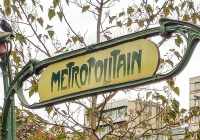
The Parisian subway is known as the Metro, short for “chemin de fer Métropolitain” [metropolitan railway].  The network of underground rail lines has 245 stations scattered throughout central Paris’ 20 “arrondissements” [districts].

Tickets for the Paris Metro are purchased from blue or green “billetteries” [ticket vending machines] or from “guichets” [manned ticket windows] within stations. The current price (July 2008) for a single ticket known as a “Ticket t+” is €1,60. Tickets can also be purchased as a book of ten or twenty, known as a “carnet” [booklet], for a slight discount (booklet of ten Ticket t+ is €11,40 or €1,14 each).

Paris Metro Ticket t+

During your journey, keep your ticket with you until you arrive at your destination station and pass through the exit gates or turnstiles.  “Controleurs” [ticket inspectors] may stop you at any point during your journey to ask to see a valid ticket or pass.  Failure to provide a valid fare will result in a fine of €35, payable on the spot through credit card.

Paris Metro stations are mostly located underground with a few above ground due to local geography. Entry into the Metro stations is free up until the turnstiles which mark the area from which you must have a valid transportation ticket or pass. Some station entrances are unmanned, having no ticket window nor ticket vending machines, only turnstiles which accept tickets and smart card passes (Pass Navigo) for entry.

Metro lines are numbered from 1 to 14, each a different color, with two “bis” [b or secondary] lines making 16 in total.

Each Metro line has two (or more) terminus stations. These end-of-line stations are used to note the direction the train is traveling. Each Metro line platform within a station will be marked with the line number and the direction the trains will travel from that platform.

Signs within Paris Metro stations mark the way to train platforms on a given line, in a given direction. Metro lines are signified by the letter M within a circle.There are several Metro stations that serve multiple lines in various directions. This causes some stations to have several vertical levels accessible sometimes only by stairs, but often with escalators and sometimes with elevators for extremely deep stations.

As you make you way toward the line platforms within a station, stairs often descend or ascend onto the either side of the rails.  Each stairwell is often marked with a detailed Metro line sign showing number, direction, and stations that will be visited as the train travels toward the terminus.

(photo by roboppy)

Exits from Metro stations are marked by blue “sortie” [exit] signs and often note the street or area they give access to.

(photo by kygp)

Stations often have several exits leading out to various streets and pathways.  There is often a map provided within the station, outside of the ticketed turnstile area, but still within the station, showing all exits in relation to above ground streets and establishments.

Links

Paris Metro Google Knol

Paris Metro Line Schedule/Timetable with frequency and neighborhood maps for stations

More Metro photos & information at nycsubway.org

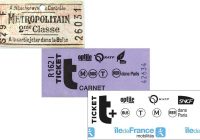
paris metro ticket tThe ticket t (mauve color) or ticket t+ (white color) is the current single ticket for use on Paris regional transport methods including:

  • Metro
  • RER (within Zone 1)
  • Tramways (including T4 after July 2008),
  • RATP buses
  • Noctilien buses (night bus)
  • Optile buses (Paris suburbs)
  • Cable car of Montmarte (Funiculaire de Montmarte)

Ticket t is currently priced at €1,60 for a single ticket (as of July 2008). A package of 10 tickets, a carnet ["car-nay"] costs €11,40.

The ticket t can be used for transfers, made within 1 hour 30 minutes of first use, only between certain methods of transport and depending on the type of transport used. You cannot mix and match the transfers listed below, each bullet point should be regarded as separate transfer type. For example, you cannot transfer from Metro to Bus. Ticket t transfers are allowed between:

  • Metro lines, without exiting the confines of a station, or
  • Metro and RER lines, or
  • 2 RATP Bus lines, or
  • 1 RATP Bus and 1 Optile bus, or
  • Tramway and any bus lines that cross it, or
  • Noctilien buses (except on Noctilien buses requiring special fares)

Notice that there are no “and”s in the above list. That’s on purpose. You can’t mix any of the above transfer situations.

Special note: single tickets purchased on buses, directly from drivers are often not valid for transfers and appear like this:

ticket t no transfers

With these tickets you will not be able to transfer to another bus nor tramway.

References: RATP